Research

Quantum vacuum

Numerical study of light-by-light scattering scenarios
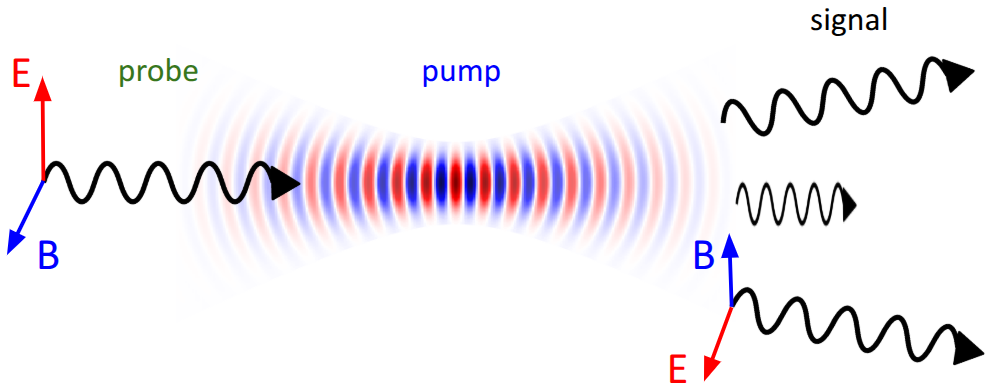
Strong-field QED predicts that in the presence of strong electromagnetic fields the quantum vacuum starts to behave like a medium and affects light propagation. Due to this nonlinear interaction, the incoming photon might change its direction, energy and polarization. For currently achievable laser intensities the effect is really small and presents a huge experimental challenge.

Objectives: Investigate potentially promising collision configurations that maximize the discernible signal.
Thumbnail

Projects:

  1. M. Valialshchikov, F. Karbstein, D. Seipt and M. Zepf, “Back-reflection in dipole fields and beyond”, Phys. Rev. D 112, 2025
    DOI:10.1103/129l-c43n
  2. N. Ahmadiniaz, et al, “Towards a vacuum birefringence experiment at the Helmholtz International Beamline for Extreme Fields (Letter of Intent of the BIREF@ HIBEF Collaboration)”, High Power Laser Science and Engineering 13, 2025
    DOI:10.1017/hpl.2024.70
  3. M. Šmíd, et al, “Proof-of-principle experiment for the dark-field detection concept for measuring vacuum birefringence”, Phys. Rev. A 112.6, 2025
    DOI:10.1103/xpxy-ntwz
  4. M. Valialshchikov, F. Karbstein, D. Seipt and M. Zepf, “Numerical optimization of quantum vacuum signals”, Phys. Rev. D 110.7, 2024
    DOI:10.1103/PhysRevD.110.076009
Machine Learning in Physics

Objectives: Investigate which Machine Learning (or Deep Learning) algorithms would benefit the area of strong-field QED.

Thumbnail

Projects:

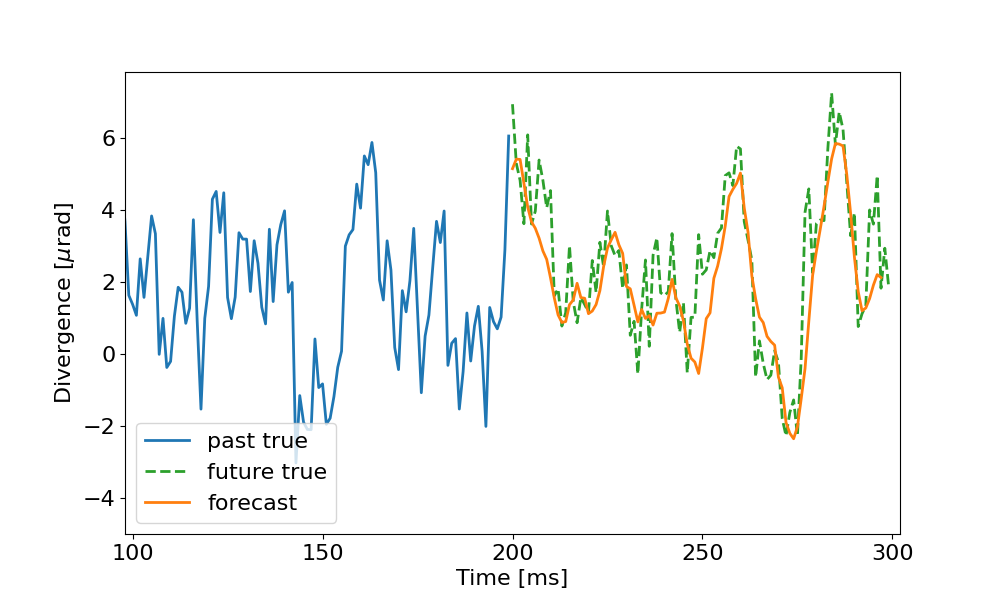
  1. M. Valialshchikov, A. Saevert, M. Zepf, “Spatial laser jitter prediction with neural networks”: time series prediction on temporal and short-time Fourier transform features with fast inference and decent prediction quality. Tested architectures vary from basic RNNs to probabilistic forecasters (e.g. Autoformer), 2023-2025
    Initial project steps are available on Github
  2. M. Valialshchikov, D. Seipt, “Neural network interpolator for particle transition rates in PIC codes”: PIC codes with QED have interpolation tables for the rates of QED processes (photon emission and Breit-Wheeler pair creation). Sampling from these tables takes a lot of time. Replacing all tables with basic Neural Network surrogate model might speed up the simulations, 2022
  3. M. Valialshchikov, S. Rykovanov, “Physics Informed Neural Networks for Schroedinger and Dirac equation”: PINNs represent a promising way towards finding a solution for nonlinear PDEs, 2022

Thomson/Compton scattering

Development of Thomson/Compton photon sources
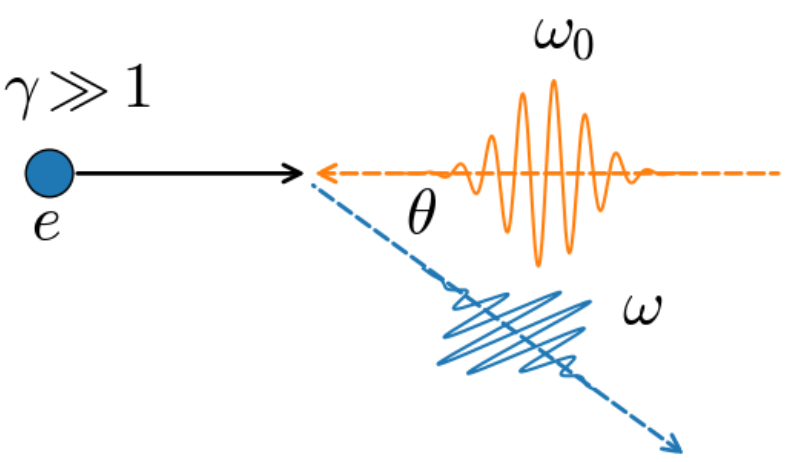
The scattering of intense laser pulses on high-energy electron beams is a well-established method for generating x and γ radiation with applications in medicine, ultrafast radiography, and nuclear physics. Small intensities of an incident laser pulse lead to meager photon yields. Increasing laser intensity helps to boost photon yields, but also brings nonlinear effects into play, i.e., the spectrum is redshifted and high harmonics are generated. For temporally pulsed lasers, it also leads to a significant spectral ponderomotive broadening, which severely limits practical applications of such source.

Objectives: 1) Propose and study methods to reduce the bandwidth of the nonlinear Thomson photon source. 2) Study distinctive signatures of Thomson scattering in the emitted photon spectrum.

Thumbnail

Projects:

  1. M. A. Valialshchikov, D. Seipt, V. Yu. Kharin, and S. G. Rykovanov, “Towards high photon density for Compton scattering by spectral chirp”, Phys. Rev. A 106.3, 2022
    DOI:10.1103/PhysRevA.106.L031501
  2. M. Ruijter, V. Petrillo, T. C. Teter, M. A. Valialshchikov, and S. G. Rykovanov, “Signatures of the carrier envelope phase in nonlinear Thomson scattering”, Crystals 11(5), 2021
    DOI:10.3390/cryst11050528
  3. M. A. Valialshchikov, M. Ruiter, and S. G. Rykovanov, “On the usage of tapered undulators in the measurement of interference in the intensity-dependent electron mass shift”, Crystals 11.5, 2021
    DOI:10.3390/cryst11050486
  4. M. A. Valialshchikov, V. Yu. Kharin, and S. G. Rykovanov, “Polarisation gating technique in nonlinear Compton scattering: effect of radiation friction and electron beam nonideality”, Quantum Electronics 51.9, 2021
    DOI:10.1070/QEL17616
  5. M. A. Valialshchikov, V. Yu. Kharin, and S. G. Rykovanov, “Narrow bandwidth gamma comb from nonlinear Compton scattering using the polarization gating technique”, Phys. Rev. Lett. 126.19, 2021
    DOI:10.1103/PhysRevLett.126.194801